
 | Chapter 3 – The White Bear Der Weiße Bär – Kapitel 3 L’Ours Blanc – Chapitre 3 | 30 – Sideshows 30 – Die Nebenhandlung 30 – Problèmes mineurs |  |
| Chapter 3 – The White Bear Der Weiße Bär – Kapitel 3 L’Ours Blanc – Chapitre 3 | 30 – Sideshows 30 – Die Nebenhandlung 30 – Problèmes mineurs | |
Map of The Holy Country
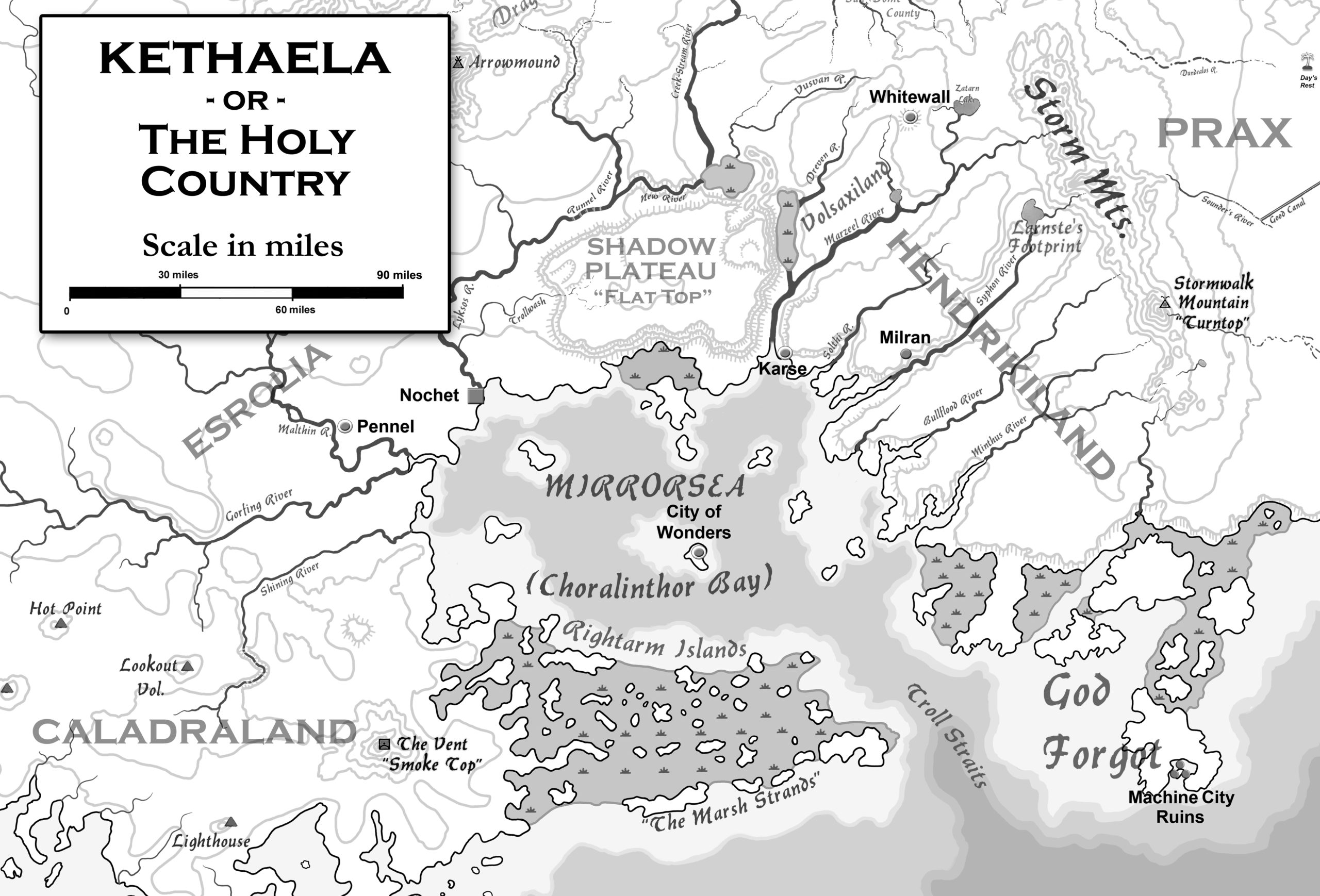
The Holy Country
To the south of Dragon Pass lies the magical land of the Holy Country, united for centuries by its ever reincarnating God-King Belintar. Six nations coexist in harmony in this kingdom, drawing on the ancient knowledge of the four directions, and from the Darkness beneath the earth and from the deep waters.
The six lands are:
Caladraland: This land of volcanic hills and peaks is dominated by the Vent, the home of the god Veskarthan the Deep (often called Lodril), a cone over 7,000 feet high and regularly smoking.
Esrolia: this rich and densely-populated civilized land is favored by the goddess Ernalda. It is ruled by queens and matriarchs, although its people are Orlanthi and closely related to the Heortlings of Sartar. Esrolia is home to Nochet, the largest and richest city in the world.
Heortland: This high plateau is also known as Hendrikiland. The people here are mostly farmers, Heortlings who worship Orlanth as the king of the gods, and Ernalda as his wife. The northern third of Heortland, around the fortress city of Whitewall, is functionally independent, having successful rebelled against the Holy Country more than two generations ago.
God Forgot: These islands are named after the wail of its inhabitants who long bemoaned the loss of their favorite deity. They refused to worship other gods and developed a radical materialist belief. They are ruled by ancient immortals who use the Brithini forms of life and government. Their ruler is called the Talar, and he is advised by undying sorcerers.
The Rightarm Islands: These islands are inhabited by fishmen, but are governed by the ludoch merfolk who live beneath the waves. A single High Admiral of the Boats is appointed by the mer-chief.
The Shadow Plateau: This vast black plateau is all that is left of the once immense Palace of Black Glass which the Volcano God made for his master Argan Argar, the Lord of Night. All that now remains is a land of ghosts, black sand, and a great bubbling tarpit where the center of the Only Old One’s palace once stood. It is called the Haunted Lands and is ruled by dark trolls.
Das Heilige Land
Südlich des Drachenpasses liegt das magische Heilige Land, das seit Jahrhunderten durch seinen immer wieder reinkarnierenden Gottkönig Belintar vereint ist. Sechs Nationen leben in diesem Königreich in Harmonie zusammen mit Hilfe des alten Wissens über die vier Richtungen, der Dunkelheit unter der Erde und des tiefen Wassers.
Die sechs Länder sind:
Caladraland: Dieses Land ist voll von vulkanischen Hügeln und Gipfeln, von denen der beeindruckendste der Schlot ist, ein über 2100 Meter hoher Berg, aus dem es häufig raucht und der die Heimat des Gottes Veskarthan, des Tiefen (der auch oft Lodril genannt wird), ist.
Esrolia: Dieses reiche und vielbevölkerte zivilisierte Land wird von der Göttin Ernalda bevorzugt. Es wird von Königinnen und Matriarchen beherrscht, auch wenn die Bevölkerung aus Orlanthi besteht, die mit den Heortlingern aus Sartar eng verwandt sind. In Esrolia liegt auch Nochet, die größte und reichste Stadt der Welt.
Heortland: Dieses Hochplateau wird auch Hendrikiland genannt. Die Heortlinger hier sind hauptsächlich Farmer und verehren Orlanth als König der Götter und Ernalda als seine Frau. Das nördliche Drittel von Heortland, das um die Festungstadt Weißwall herum liegt, ist unabhängig, da es vor über zwei Generationen erfolgreich gegen das Heilige Land rebellierte.
Gottvergaß: Diese Inseln heißen nach dem Klageruf seiner Bewohner, die den Verlust ihres Lieblingsgottes betrauern. Sie weigerten sich, andere Gottheiten anzubeten, und entwickelten einen radikalen materialistischen Glauben. Sie werden von uralten Unsterblichen beherrscht, die die Lebensart und Regierungsform der Brithini verwenden. Ihr Herrscher wird der ‚Talar‘ genannt und von unsterblichen Zauberern beraten.
Die Rechtsarm-Inseln: Diese Inseln werden von Fischern bewohnt, aber von den Ludoch-Meermenschen regiert, die unter Wasser leben. Ein einzelner Oberadmiral der Boote wird von dem Häuptling der Meermenschen eingesetzt.
The Shadow Plateau: Das riesige schwarze Plateau ist alles, was von dem einst gigantischen Palast des Schwarzen Glases übrigblieb, den der Vulkangott für seinen Meister Argan Agar, den Herr der Nacht, erschuf. Alles was nun bleibt, ist ein Land voller Geister, schwarzem Sand, und eine große blubbernde Teergrube, wo einst das Zentrum des Palastes des Einzigen Alten war. Es wird auch das Ruhelose Land genannt und von Dunkeltrollen beherrscht.
Le Pays Saint
Au sud de la Passe du Dragon s’étendent les contrées magiques du Pays Saint, uni depuis des siècles par Belintar, son Roi-Dieu aux réincarnations constantes. Dans ce royaume, six nations coexistent en harmonie, et elles tirent leur sagesse des quatre directions, ainsi que des Ténèbres dans les profondeurs de la terre et de la mer.
Ces six pays se nomment :
La Terre de Caladra: Sur cette terre volcanique parsemée de collines et de hautes cimes domine le Vent, volcan de plus de 2 100 mètres de haut constamment en activité. Cette montagne est aussi le lieu de résidence du dieu Veskarthan le Pénétrant (aussi connu sous le nom de Lodril).
L’Esrolie: Ce pays riche, civilisé, et fortement peuplé est privilégié par la déesse Ernalda qui y réside. L’Esrolie est dirigé par des reines et des matriarches, bien que ses habitants, des orlanthiens, soient de proches parents des Héortiens de Sartar. Dans se pays se trouve Nochet, la plus grande, et la plus riche, cité du monde. .
Le Pays d’Héort: Ce haut plateau, aussi connu sous le nom de Pays d’Hendriki, est principalement habité par des paysans. Les Héortiens vénèrent Orlanth comme roi des dieux, et Ernalda comme son épouse. Au nord, un tiers du Pays d’Héort situé autour de la ville-forteresse de Whitewall, fonctionne de manière indépendante depuis plus de deux générations après être parvenu à se rebeller contre le Pays Saint.
Les îles du Dieu Perdu: Le nom de ces îles provient des cris de lamentation de ses habitants suite à la perte de leur divinité tutélaire. Suite à cela, ils refusèrent de vénérer tout autre dieu et ils se mirent à développer des croyances radicales fondées sur le matérialisme. Ces îles sont dirigées par de très anciens immortels au mode de vie et de gouvernement brithinis. Leur dirigeant se nomme Talar et il est entouré de sorciers à la vie éternelle qui lui servent de conseillers.
Les îles du Bras Droit: Ces îles de pêcheurs sont gouvernées par les Ludoch, le Peuple des Mers qui vit sous les vagues. Le Grand-Amiral des Navires est toujours nommé par le chef des Ludoch.
Le Plateau des Ombres: Ce gigantesque plateau noir est tout ce qu’il reste de l’immense Palais de Verre noir que le Dieu Volcan avait bâti pour son maître, Argan Argar, Seigneur de la Nuit. Aujourd’hui, il n’en subsiste qu’une terre de fantômes, de sable noir, ainsi qu’un grand puits de bitume bouillonnant où autrefois se dressait le palais du Seul Ancien. Désormais appelées les Terres Hantées, elles sont dirigées par les trolls sombres.
The Six
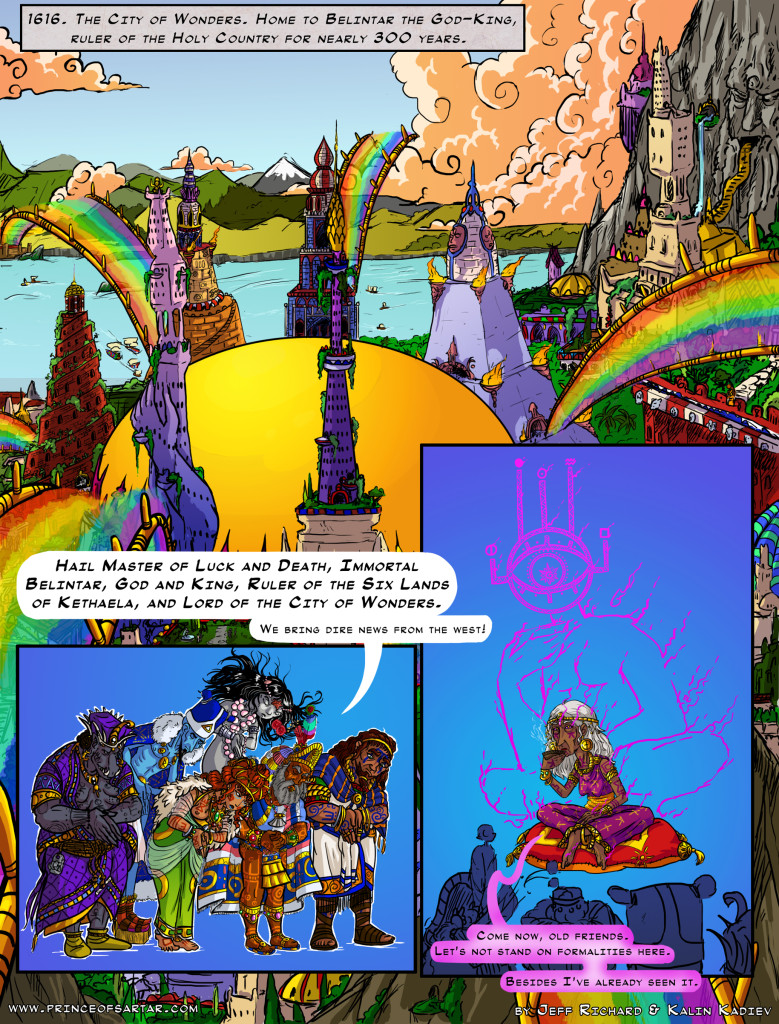
Here we see the representatives of the Six Lands of Holy Country present themselves to Belintar the God-King. They are:
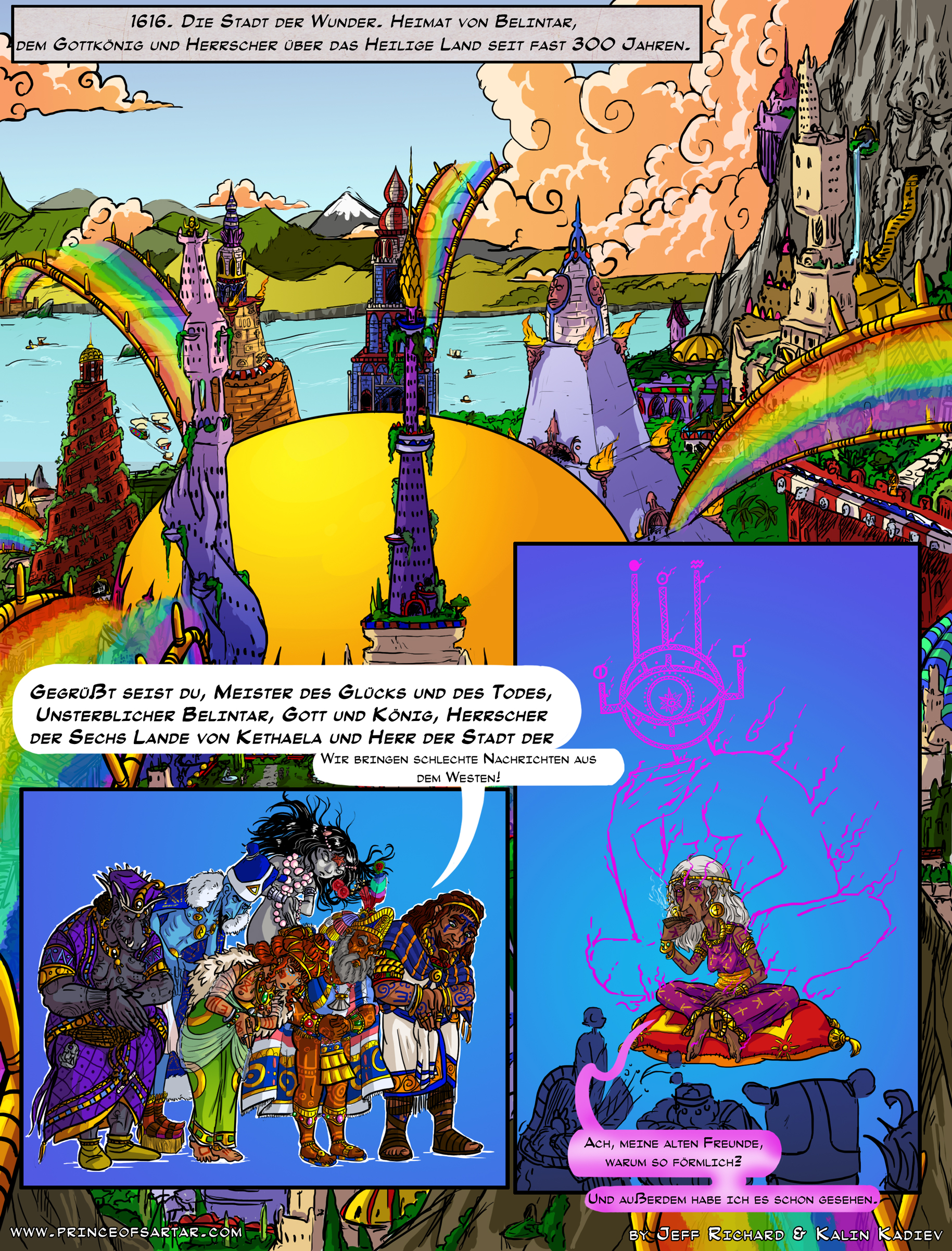
Die Sechs
Hier sehen wir die Abgesandten der Sechs Länder des Heiligen Lands, die bei Belintar vorstellig werden. Von links nach rechts sind dies:
Les Six
Nous pouvons voir ici les représentants des Six Régions du Pays Saint en audience auprès de Belintar le Roi-Dieu. Nous avons, de gauche à droite :
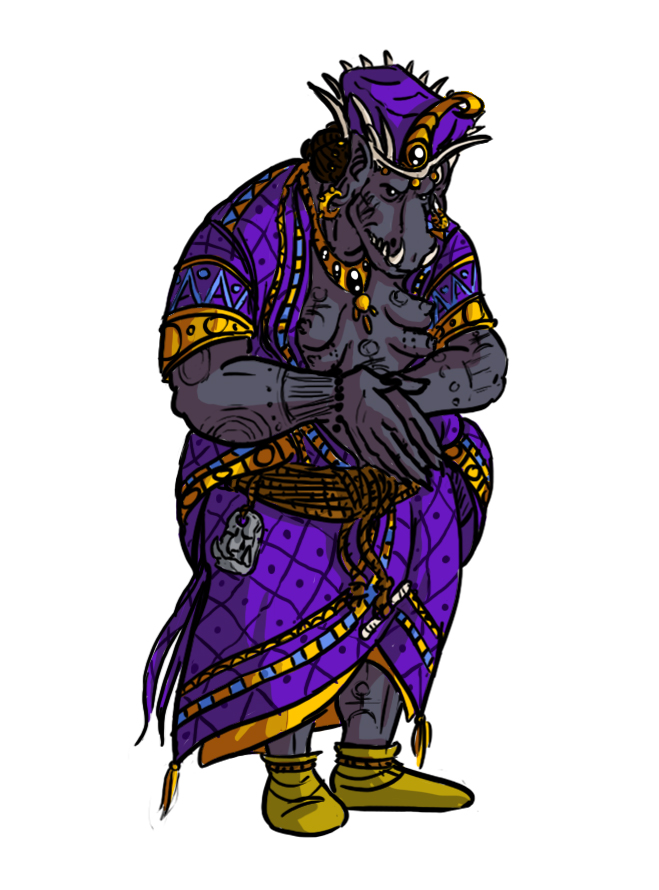
Xoroho Hellspeaker
Xoroho Hellspeaker, envoy from the Eldest Kin of the Shadow Plateau. She is an old and powerful dark troll, daughter of a line of mothers reaching back to the eldest daughter of Xiola Umbar. A powerful priestess of both Argan Argar and Kyger Litor, Xoroho is the mistress of the dark powers that fought against Belintar, and yet has advised many incarnations of Belintar. She is friendly with many humans and her diplomacy has ensured that the trolls enjoys the support of the Master of Luck and Death.
Xoroho Höllensprach
Xoroho Höllensprach, die Abgesandte der Ältesten Sippe des Schattenplateaus. Sie ist eine alte und mächtige Dunkeltrollfrau aus einer langen Linie von Müttern, die zur ältesten Tochter von Xiola Umbar zurückreicht. Als mächtige Priesterin von sowohl Argan Argar als auch Kyger Litor ist Xoroho die Meisterin der dunklen Mächte, die einst gegen Belintar kämpften, jedoch hat sie auch mehrere Inkarnationen von Belintar beraten. Sie ist mit vielen Menschen befreundet, und ihre diplomatischen Fähigkeiten haben dafür gesorgt, dass die Trolle durch den Meister des Glücks und des Todes unterstützt werden.
Xoroho Voix des Enfers
Xoroho Voix des Enfers, une envoyée des Doyennes du Plateau des Ombres. Ce puissant troll sombre d’un âge avancé est la fille d’une lignée de matriarches qui remonte jusqu’à la fille ainée de Xiola Umbar. Cette prêtresse aux grands pouvoirs qui sert à la fois Argan Argar et Kyger Litor est détentrice des sombres pouvoirs qui luttèrent contre Belintar. Cependant, Xoroho a prodigué ses conseils auprès de diverses incarnations de Belintar à de nombreuses reprises.
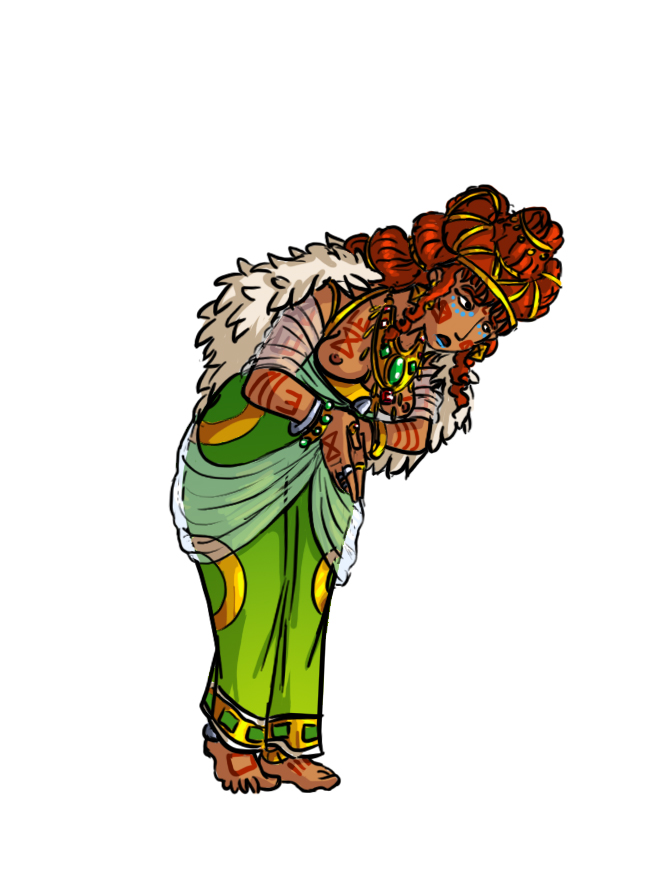
Queen Hendira
The queen of Esrolia is a 35 year old noblewoman from House Norinel. She has been queen for the last 6 years and has two husbands (Jarstarkos of Delaeo and Hendrestos of Delainaeo). She broadly enjoys the support of the Grandmothers’ Council (the matriarchs who rule most of the clans in Esrolia). Hendira is shrewd, manipulative, voracious, and is willing to do almost anything to get what she wants. She maintains a close alliance with the Eldest Kin of the Shadow Plateau, who have provided her with a bodyguard of troll mercenaries.
Königin Hendira
Die Königin von Esrolia ist eine 35 Jahre alte Edelfrau aus dem Hause Norinel. Sie ist seit 6 Jahren die Königin und hat zwei Ehemänner (Jarstarkos von Delaeo und Herdrestos von Delaeo). Sie wird von dem größten Teil des Großmütter-Rates (den Matriarchen, die die meisten Clans in Esrolia beherrschen) unterstützt. Hendira ist gerissen , manipulativ, gierig und bereit, fast alles zu tun, um zu bekommen, was sie will. Sie unterhält eine enge Verbindung mit der Ältesten Sippe des Schattenplateaus, die ihr eine Leibwache aus Trollsöldnern zu Verfügung stellt.
La Reine Hendira
Cette noble de 35 ans issue de la Maison Norinel est Reine d’Esrolie depuis 6 ans et a deux époux (Jarstarkos de Delaeo et Hendrestos de Delainaeo). Elle bénéficie grandement du soutien du Conseil des Matriarches (à la tête de la plupart des clans d’Esrolie). Rusée, manipulatrice, et d’une ambition dévorante, Hendira est prête à tout pour obtenir ce qu’elle veut. Elle entretient une alliance étroite avec les Doyennes du Plateau des Ombres, qui lui a mis à disposition une escorte de gardes du corps composée de mercenaires trolls.
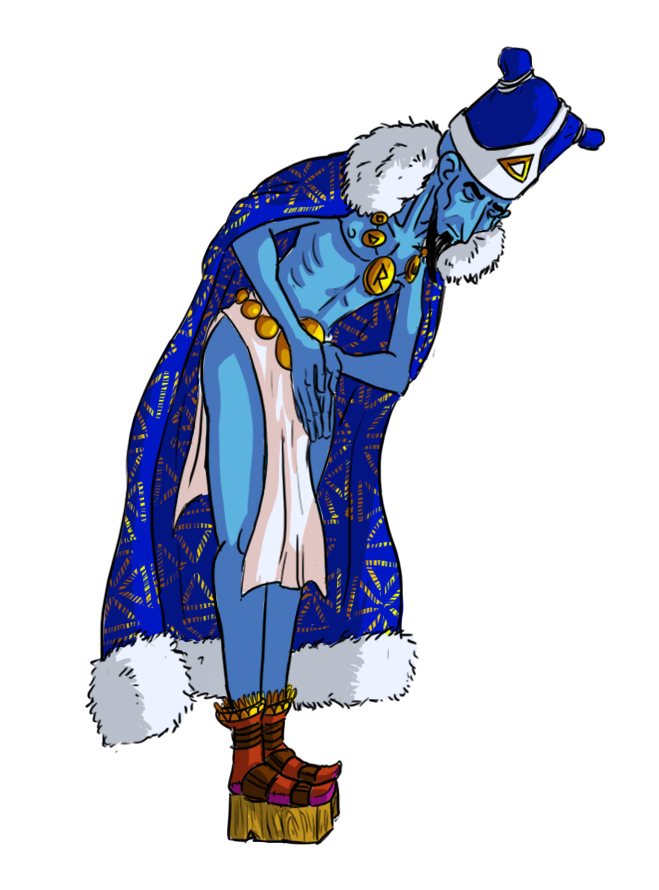
Carvak Zirian
Carvak Zirian, the mind of the Talar. Known to be more than three hundred years old (his actual age is a mystery), he has served Belintar since the Stranger first arrived in Kethaela. Carvak Zirian is a materialist sorcerer who views the gods as magical entities to be studied and controlled, rather than worshiped.
Carvak Zirian is friendly with many Lhankor Mhy sages. Two generations ago, his correspondence with Master Bondaru concerning the physical body and its ethereal attributes greatly enhanced the Knowledge Temple’s understanding of Second Age Jrusteli texts.
Carvak Zirian
Carvak Zirian ist der Geist der Talar. Sein genaues Alter ist nicht bekannt, nur dass er über dreihundert Jahre alt ist. Er dient Belintar, seit der Fremde zuerst in Kethaela ankam. Carvak Zirian ist ein materialistische Zauberer, der Götter als magische Wesen sieht, die studiert und kontrolliert werden sollten, anstatt verehrt zu werden.
Carvak Zirian ist mit vielen Weisen Lhankor Mhys befreundet. Vor zwei Generationen hat seine Korrespondenz mit Meister Bonarum zum Thema des physischen Körpers und seiner spirituellen Merkmale das Verständnis stark erweitert, das der Wissenstempel über die Texte der Jrusteli des Zweiten Zeitalters hat.
Carvak Zirian
Carvak Zirian, la tête pensante de Talar. Âgé soi-disant de plus de trois cents ans (bien que son âge véritable demeure un mystère), il est au service de Belintar depuis l’arrivée de l’Étranger à Kathaéla. Carvak Zirian est un sorcier matérialiste qui considère les dieux comme des entités magiques pouvant être étudiées et contrôlées plutôt que vénérées. Carvak Zirian entretient de très bonnes relations avec de nombreux érudits de Lhankor Mhy. Il y a deux générations de cela, ses échanges écrits avec Maître Bondaru sur les propriétés éthérées du corps matériel permirent au Temple de la Connaissance d’accroître considérablement sa compréhension des textes jrustéliens datant du Second Âge.
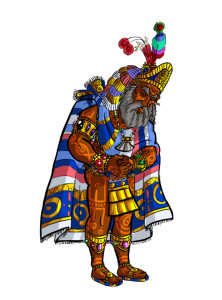
Verakanos Bluesmoke, High King and Governor of the Sixth of Caladraland. He is a long-time ally of the current incarnation of Belintar, and aided him in the Tournament of the Masters of Luck and Death. This is his second (non-consecutive) term as High King. Verakanos has fought many campaigns against the Western Barbarians in Thomble and he is considered the best warleader of the Six.
Verakanos Blaurauch, Er ist der Hochkönig und Gouverneur von Caladraland. Er ist seit Langem ein Verbündeter der derzeitigen Inkanation von Belintar und hat ihn bei dem Turnier des Meisters des Glücks und des Todes unterstützt. Dies ist seine zweite (nicht-konsekutive) Amtszeit als Hochkönig. Verakanos hat viele Kampagnen gegen die westlichen Barbaren in Thromble geführt und gilt als bester Kriegsführer der Sechs.
Verakanos Brume Bleue, Haut Roi et gouverneur du Sixième qui correspond à la Terre de Caladra, il demeure un allié de longue date de l’incarnation actuelle de Belintar. Il lui a notamment apporté son aide lors du Tournoi des Maîtres de la Chance et de la Mort. Verakanos en est à son deuxième mandat (non consécutif) en tant que Haut Roi, et il a mené de nombreuses campagnes contre les barbares de l’Ouest à Thomble. Il est considéré comme le meilleur chef de guerre des Six.
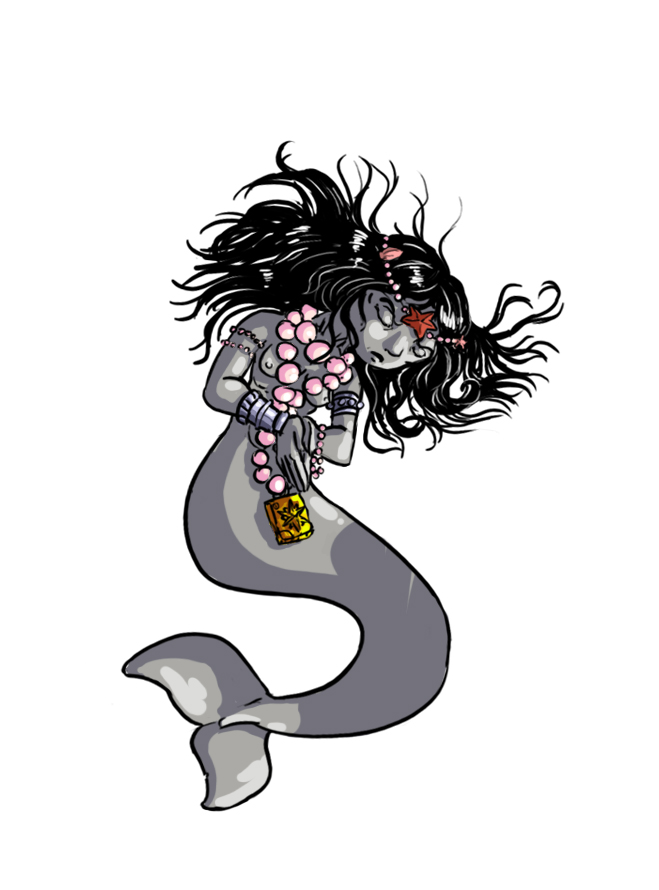
Sednadimos, Daughter of the Deep. A daughter of the mysterious mer-chief of the Choralinthor ludoch, Sednadimos provides Belintar with the counsel of the Deep. She, and her people, are strongly allied to the immortal God-King and make sure that none travel on the Rozgali or Choralinthor Seas without Belintar’s knowledge.
Sednadimos is a powerful magician and priestess of Magasta. She can speak all of the languages of the surface dwellers of Kethaela and can even write! Sednadimos is revered and worshiped by the humans of the Right Arm Islands.
Sednamidos, Tochter der Tiefe. Diese Tochter des mysteriösen Meerhäuptlings der Ludochs von Choralinthor übermittelt Belintar den Ratschlag der Tiefe. Sie und ihr Volk sind eng mit dem unsterblichen Gottkönig verbunden und sorgen dafür, dass niemand auf den Rozgali- oder Choralinthor-Meeren reist, ohne dass Belintar davon weiß.
Sednamidos ist eine mächtige Magierin und eine Priesterin von Magasta. Sie kann alle Sprachen der Oberflächenbewohner von Kethaela sprechen und sogar schreiben. Sednamidos wird von den Menschen der Rechtsarm-Inseln verehrt und angebetet.
Sednamidos, Fille des Profondeurs. . Elle est l’une des filles du mystérieux chef du Peuple des Mers, dirigeant des Ludoch de la mer Choralinthor. Conseillère des Profondeurs auprès de Belintar, Sednamidos et son peuple sont de grands alliés de l’immortel Roi-Dieu, et ils s’assurent que personne ne puisse s’aventurer sur les mers de Rozgali et de Choralinthor sans que celui-ci en soit informé.
Sednamidos est aussi une puissante magicienne et prêtresse de Magasta. Elle sait parler, mais aussi écrire, toutes les langues des habitants de la surface de Kathaéla. Sednamidos est révérée et vénérée par les humains des îles du Bras Droit.
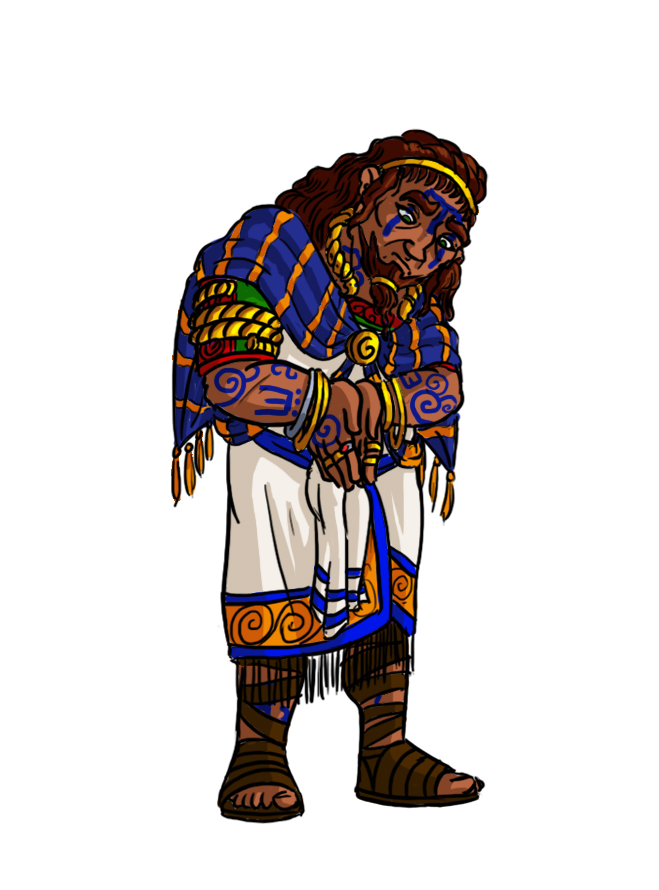
Orngerin the Sophisticate, King and Governor of Heortland. He is a wise and just ruler of the Orlanthi, who keeps the peace in Heortland despite the provocations of the Volsaxi rebels at Whitewall. He was appointed governor in 1603 with much promise and hope, a patron of the arts and scholarship and all things good and decent.
Orngerin der Kultivierte. Er ist der König und Gouverneur von Heortland. Er ist ein weiser und gerechter Herrscher der Orlanthi, der trotz der Provokationen der Volsaxi-Rebellen von Weißwall den Frieden in Heortland aufrecht erhält. Er wurde 1603 zum Gouverneur ernannt und gilt als Patron der Künste und des Wissens und Allem, was gut und anständig ist.
Orngerin le Sophistiqué, Roi et Gouverneur du Pays d’Héort, il dirige les Orlanthi avec droiture et équité. Il maintient la paix dans le pays d’Héort malgré les provocations incessantes des rebelles volsaxi à Whitewall. Il fut nommé gouverneur en 1603, et sur lui ont toujours résidé de très grands espoirs. Orngerin est aussi un érudit, un mécène, mais aussi un symbole de décence et de grandeur.
Belintar the God-King
Nobody knows who Belintar was or where he came from, though there are many stories and theories. Some claim that he was the Golden Age ruler of Kethaela, from before the Vingkotlings and the Only Old One, returned to his land. Others claim that he was the destroyer of the Middle Sea Empire and came to protect the people of Kethaela. Still others claim he was a simple sea captain, or even a sailor, who magically survived the Closing.
When Belintar arrived, nobody knew what he was or initially believed his claims, but Belintar proved to all he was God-King of the Holy Country. He accomplished this by demonstrating to the many peoples of Kethaela the lawfulness and virtues of his rule and they helped him destroy the Only Old One. This process involved revelations by and about Belintar, remarkable appearances, magical contests, violence, war, and the occasional surprises that were not what anyone expected.
Since 1336, the mortal body of Belintar had expired 21 times. Each time, the Tournament of the Masters of Luck and Death produced a new body, sometimes male, sometimes female, sometimes even an Elder Race.
Belintar der Gottkönig
Niemand weiß, wer Belintar war oder wo er herkam, obwohl es dazu viele Legenden und Theorien gibt. Einige behaupten, er wäre in der Goldenen Ära der Herrscher von Kethaela gewesen (noch vor den Vingkotlingen und dem Einzigen Alten), der nun in sein Land zurückgekehrt ist. Andere sagen, er wäre der Zerstörer des Mittelsee-Imperiums gewesen und gekommen, um das Volk von Kethalea zu schützen. Und einige meinen, dass er ein einfacher Seekapitän oder sogar Seemann war, der auf wundersame Weise der Schließung der Meere entkam.
Als Belintar ankam, wusste keiner, wer er war, und niemand glaubte seinen Behauptungen, doch bald bewies er, dass er der Gottkönig des Heiligen Landes war. Er erreichte dies, indem er den vielen Völkern in Kethaela die Rechtmäßigkeit seiner Herrschaft bewies, und diese unterstützten ihn, als er den Einigen Alten vernichtete. Dieser Vorgang involvierte viele Offenbarungen durch und über Belintar, beeindruckende Auftritte, magische Wettbewerbe, Gewalt, Krieg und so manche Überraschung, mit der nun wirklich niemand gerechnet hätte.
Seit 1336 ist die Sterbliche Hülle von Belintar schon 21 Mal dahingeschieden. Jedes Mal hat das Turnier des Meisters des Glücks und des Todes einen neuen Körper hervorgebracht, manchmal männlich, manchmal weiblich und manchmal sogar aus einer der Älteren Rassen.
Belintar le Roi-Dieu
Personne ne sait qui était Belintar avant qu’il n’arrive, ni d’où il est originaire, bien qu’il existe de nombreuses légendes et théories à ce sujet. Certaines prétendent qu’il était le dirigeant de Kathaéla lors de l’Âge d’Or, bien avant l’époque des Vingkotiens et de l’Ancien Unique, et qu’il revint ensuite sur ses terres. D’autres disent qu’il détruisit l’Empire de la mer du Milieu, puis décida de protéger les habitants de Kathaéla. D’autres racontent aussi qu’il n’était uniquement qu’un capitaine de navire, voire même juste un simple marin qui aurait survécu à la Clôture.
Lorsque Belintar arriva en Kathaéla, personne ne connaissait son identité ni ne croyait en ses prétentions. Cependant, il prouva à tous qu’il était bien le Roi-Dieu du Pays Saint en montrant aux nombreux peuples de Kathaéla la justesse et les vertus de son règne. Ainsi, ils lui apportèrent tous son aide pour venir à bout de l’Ancien Unique. Cela demanda de nombreuses révélations produites par Belintar à son propre sujet, des aspects imposants, des compétitions de magie, des guerres, de nombreux actes de violence, ainsi que, ponctuellement, des faits exceptionnels qui prenaient tout le monde par surprise.
Depuis 1336, le corps physique et mortel de Belintar a rendu l’âme 21 fois. À chacune de ces occasions, le Tournoi des Maîtres de la Chance et de la Mort a produit un nouveau corps, parfois d’homme, parfois de femme, voire même parfois d’une Race Ancienne.
Is the Blue supplicant a Brithini Zzabur? If so, shouldn’t a Brithini Talar fulfil this function instead?
Carvak Zirion is not a supplicant, although he is a member of Belintar’s court. Carvak Zirian is the Mind of the Talar of God Forgot. Known to be more than three hundred years old (his actual age is a mystery), he has served Belintar since the Stranger first arrived in Kethaela. Carvak Zirian is a materialist sorcerer who views the gods as magical entities to be studied and controlled, rather than worshiped. Carvak Zirian is friendly with many Lhankor Mhy sages. Two generations ago, his correspondence with Master Bondaru concerning the physical body and its ethereal attributes greatly enhanced the Knowledge Temple’s understanding of Second Age Jrusteli texts.
Feb 21, 2015
Related Pages
- 30 – Sideshows
- 31 – Harbinger of the End
- 32 – Ludoch and Triremes
- 33 – Gifts and Generosity
- 34 – Repaying the God-King
- 35 – A Purple Belt
- 36 – Release the Kraken, part 1
- 37 – Release the Kraken, part 2
- 38 – Release the Kraken, part 3
- 39 – Too Strong
- 40 – The Six Guardians
- 41 – Bring it on
- 42 – More than the sum of the parts
- 43 – Some disassembly required
- 44 – Patchwork god
- 45 – Errors of Judgment
- 46 – Thief
Page Last updated: 2026-01-17 14:17:18