
New Pavis after liberation is a thriving trade city of guilds, temples, and councils—yet also the armed camp of Argrath‘s growing army. The king’s personal warband, his mercenaries, and Praxian allies fill the streets with the swagger of armed bravos, keeping the city on the constant edge of great events brewing. Fully one in four adult residents is a professional or tribal warrior loyal primarily to Argrath, making the atmosphere watchful, weapon-heavy, and tense.
Yet the city prospers like never before: markets bustle with goods from Dragon Pass, Zola Fel riverboats unload grain, and caravans swell with war supplies. Festivals roar louder, feasts grow more lavish—all funded by Lunar loot and victory spoils. It’s an armed camp infused with boomtown energy: a victorious army celebrating in a captured city that has become its triumphant base.
The city council still convenes, guilds haggle fiercely, and Pavis priests mediate disputes and perform ancient rituals—but everyone knows real power rests with the White Bull and his heroes. This is a place of glory and danger, where clever ambition or a strong arm can forge a quick fortune… or earn a swift death.
See Also


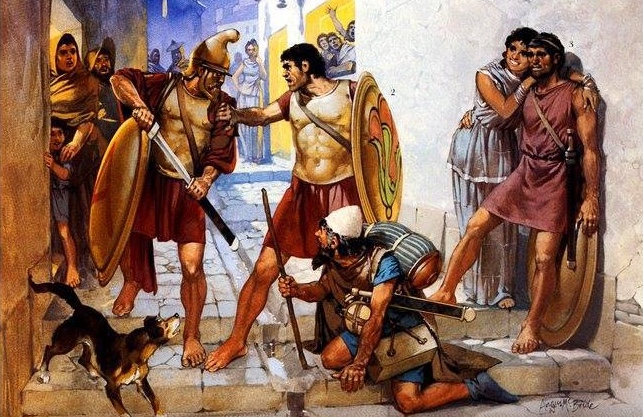
That piece from Angus McBride very much is the mental image I have for New Pavis in 1625. It is a rough bustling boomtown, with too many mercenaries and nomads for local tastes, but lots of loot and plunder to be spent.
I think some the closest RW comparisons are Hellenistic and Roman provincial cities when a charismatic king/general and his army were in residence or using it as a base, or an Old West frontier town when the Union Army is there (like in the Good the Bad and the Ugly). My mental image is Antioch on the Orontes when Antiochus III wintered there with his full army (phalangites, cataphracts, Galatian mercenaries, Indian elephants), the city swelled with troops, became a martial hub, and buzzed with victory celebrations/loot from campaigns. Civic institutions continued, but real power was the king’s court. Boomtown energy from war spending, but tense with armed foreigners everywhere.
New Pavis isn’t a grim siege camp or stagnant garrison—it’s a victorious royal base in a time of ascent. The king’s charisma and recent Lunar liberation create voluntary loyalty and excitement, not just fear. Civic life thrives because war brings wealth, but the martial overlay keeps it tense: one-in-four adults armed and loyal to the hero-king.
Now this also changes the role of the Big Rubble. Under the Lunar Occupation, access was restricted and bureaucratic. But for Argrath, the Big Rubble gives his followers something to do, something to tell stories about, and a way to prove their worth without fighting each other.
So want to go and rob Temple Hill? In 1625 or 1626 you likely can gather a band of adventurers and try it. Same thing with Blind Kings Palace or Griffin Gate or whatever. Succeed, and you likely get a a feast in your name and gifts from the White Bull. Fail and you die, so no big deal. And everyone else gets an exciting story that reinforcing that you all are adventuring heroes.
And this goes on for almost two years, and then Argrath grabs his household companions, his mercenaries, and allies, and now is off to Dragon Pass to become Prince. Maybe you come along, or maybe you stay back in the boomtown having made your fortune (and now need to deal with pissed off trolls, vampire cults, and all those enemies you made on your way up).
Which oddly enough, reminds me a lot of the storyline for HBOs Deadwood. We start with a boomtown, then become rich, then have to deal with the consequences.
When Argrath leaves, the city doesn’t collapse, but it deflates from a roaring boomtown/royal headquarters into a more ordinary frontier trade hub. But that’s the story of the Wild West.
Where does the wealth and the food come from? If you just imagine that whatever loot he and his soldiers took from seizing the governor’s treasury, the pay chests, and whatever his share of the loot from 1621-1624 was, plus whatever they took from those Lunar who took their wealth from the locals. It’s not infinite wealth, but enough to turn a stagnant occupied outpost into a boomtown for a couple years—again think like a Hellenistic successor army wintering in a newly conquered provincial capital after a successful campaign.
And since New Pavis was where he and his men spent it, that’s going to result in good times for New Pavis. Lots of money on merchants, drinks, inns, and the like. By the time that runs out, Argrath and his army are already in in Dragon Pass. That’s how this works.
Initially the Lunar Occupation was good for the town the same way. But after 1621 and the Cradle fiasco, the new governor was a lot greedier (it takes a lot of money for a new man to advance) than Sor-eel.
This also meant there was a lot of stuff of interest to caravan merchants that might be bought at a discount.
Grain comes from Pavis County and Sun County, but one thing I was always struck by going back to the original Pavis book – the importance of nomad herds as a main food source.
Now this is historically very accurate. For example, the limited arable land around frontier outposts like Alexandria Eschate (on the edge of the Fergana Valley steppe) could support basic grain production via irrigation, but not large herds for a permanent garrison of thousands. Protein-rich animal products had to come from pastoralists on the vast surrounding grasslands. Greek garrison cities like Alexandria Eschate (modern Khujand, Tajikistan) almost certainly relied on purchasing or trading for livestock from surrounding nomads (Scythians/Sakas and local pastoralists) to supplement food supplies for their soldiers.
In many ways, Argrath has it easier than the Lunars, as they had just the Sable Tribe as allies, and he can draw on most of the tribes in Prax for livestock.
Now where did his money come from? In 2025-2026 that’s easy! He took it from the Lunars!