
 | 6 – Argrath the Man 6 – Argrath der Mann 6 – Argrath l’Homme | 8 – The Wrath of Argrath 8 – Der Zorn des Argrath 8 – La colère d’Argrath |  |
7 – Argrath stellt sich den Lunaren
- Characters: Argrath
| 6 – Argrath the Man 6 – Argrath der Mann 6 – Argrath l’Homme | 8 – The Wrath of Argrath 8 – Der Zorn des Argrath 8 – La colère d’Argrath | |
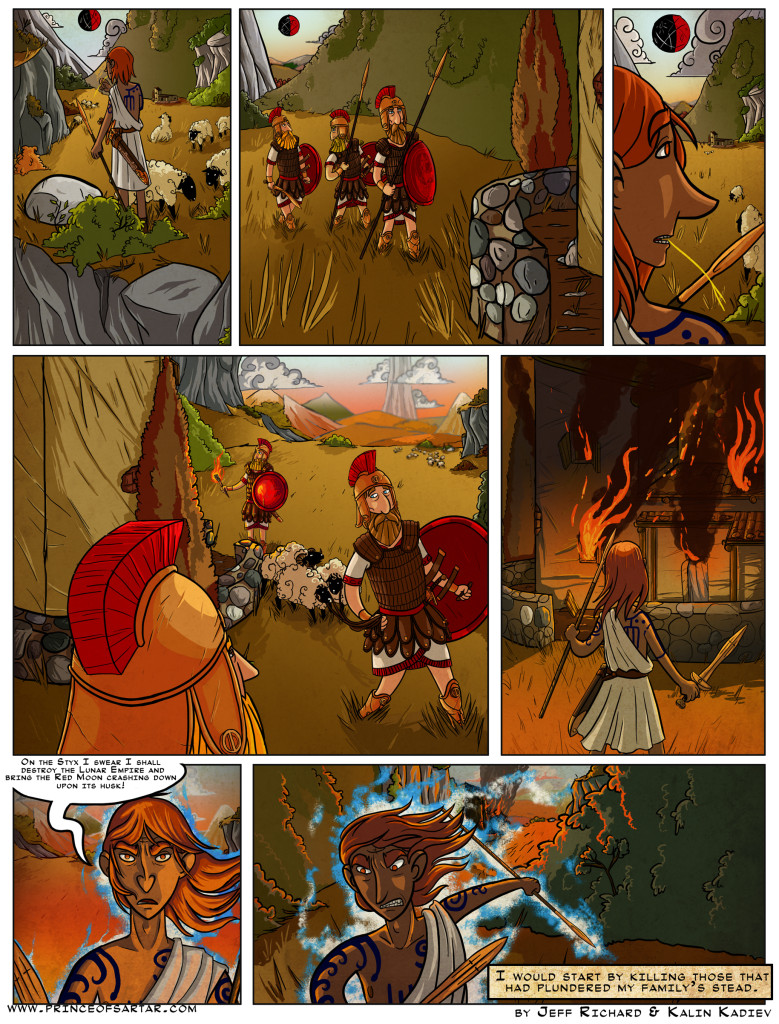
The Marble Phalanx
The hoplites here are Dara Happans from the Marble Phalanx, one of the famed Stonewall Phalanxes. They are heavy infantry that fight in phalanxes, and who have the Polestar as their patron god. They are not effective as skirmishers, and it their use here as “tax-collectors” (in this case as organized plunderers) is a possible sign of the military incompetence of Governor-General Euglyptus Assiday (popularly called “the Fat”). Several years after this incident of the Starfire Ridge, several Sartarite tribes rebelled and temporarily overthrew the Lunar occupation in what is called Starbrow’s Rebellion.
Heroforming
Argrath here is surrounded by the “Hero Light” and is channelling the power of Orlanth, his personal god, to strike down the Lunar soldiers. That Argrath can perform such a feat without being a full-time devotee of the god is a sign of his magical potency (which was also demonstrated by the depth of his initiation quest).
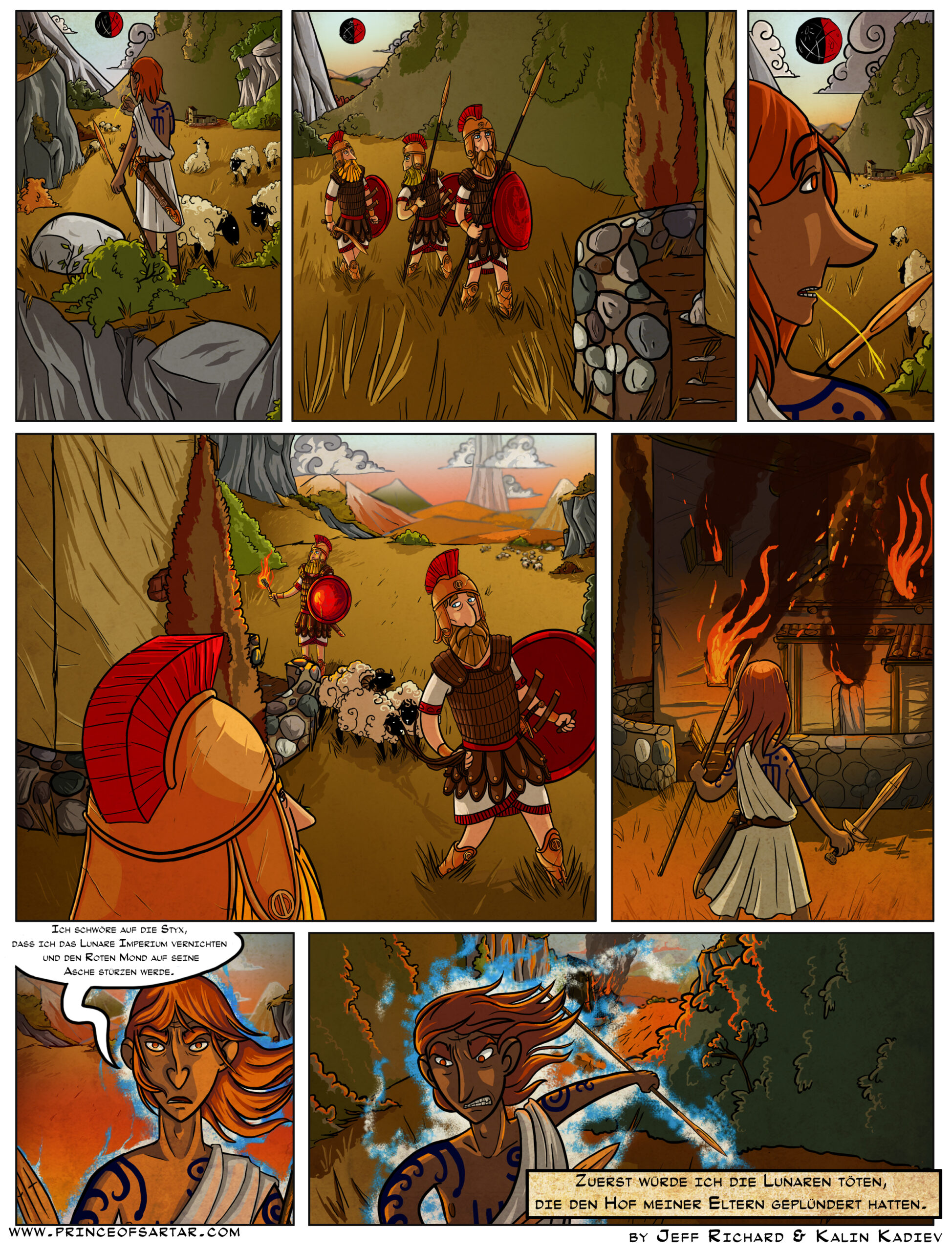
Die Marmorphalanx
Diese Hopliten stammen aus Dara Happa und gehören zur Marmorphalanx, einer der berühmten Steinwall-Phalangen. Sie gehören zur schweren Infanterie, kämpfen in einer Phalanx, und Polarstern ist ihr Schutzpatron. Sie sind keine wirkungsvollen Nahkämpfer, und ihre Beschäftigung als „Steuereintreiber“ (oder in diesem Fall, organisierte Plünderer) ist ein mögliches Anzeichen der Inkompetenz von Gouverneur-General Euglyptus Assiday (auch genannt „der Fette“). Einige Jahre nach diesem Ereignis auf dem Sternenfeuerkamm rebellierten einige Stämme der Sartariten und stürzten die Lunaren Besetzer temporär. Dies wurde Sternenstirns Rebellion genannt.
Heldenformen
Argrath ist hier vom „Heldenlicht“ umgeben und setzt die Macht Orlanths, seines Gottes, ein um die Lunaren niederzustrecken. Die Tatsache, dass Argrath dies vollbringt, ohne ein Vollzeit-Anhänger des Gottes zu sein, ist ein Zeichen seiner magischen Veranlagung (was auch durch die Tiefe seiner Initiationsqueste erkennbar ist).
La Phalange de Marbre
Les hoplites présentés sont Dara Happiens de la Phalange de Marbre, l’une des célèbres Phalanges du Mur de Pierre. C’est un corps d’infanterie lourde qui combat en phalanges et dont le dieu tutélaire est Etoile Polaire. Ils ne sont pas aussi efficaces que des éclaireurs, et leur utilisation en tant que collecteurs d’impôts (et dans ce cas de pillards organisés) est un indice possible de l’incompétence militaire du Gouverneur-Général Euglyptus Assiday (populairement appelé « le Gros »). De nombreuses années après l’incident de la Crête du Feu du Ciel, de nombreuses tribus sartarites se rebellèrent et renversèrent temporairement l’occupation Lunaire dans ce qui est appelé la Rébellion de Front d’Étoile.
Étamorphose Héroïque
Ici, Argrath est entouré par la « l’Aura Héroique » et canalise la puissance d’Orlanth, son dieu personnel, pour abattre les soldats Lunaires. Qu’Argrath puisse réaliser de tels exploits sans être un dévot à temps plein du dieu est un signe de sa puissance magique (qui est aussi montré par la profondeur de sa quête initiatrice).
Are those Lunars? They look like Yelmalions.
They are Lunars (you can usually tell by them having either the Red Goddess or the Moon Rune somewhere on them), more specifically these are soldiers from the Marble Phalanx. Looking back at it now, I think their shields should have been bigger.
September 7, 2014
Related Pages
- 1 – The Flame of Sartar
- 2 – The Uncles
- 3 – The Underworld
- 4 – Meeting the Second Son
- 5 – Argrath Faces Evil
- 6 – Argrath the Man
- 8 – The Wrath of Argrath
- 9 – Exile
- End of Chapter 1
Page Last updated: 2025-11-19 10:37:51