
This is a DEEP background post and irrelevant for most games. But I know some of you will enjoy it a lot, so I’m posting it anyway.
Let’s start with I don’t think how wildly radical the Brithini are gets fully appreciated. They achieve immortality only with an absolute adherence to the logical ordering of their society. Sex is prohibited unless it is permitted by the leaders. They are not romantic events but breeding of a new cadre of children. These events are rare – happening only every few centuries, and a sign of upcoming terrible catastrophes.
The children are taken away soon after birth and there is little or no contact between the mother and the child once that happens. The fathers are official unknown. The children are assigned to castes and trained from childhood. The norm is that all are assigned to one caste, so for example in the First Age there had been several dronar birthings to supply peasants for colonial ventures.. You get 18-30 years to almost perfectly follow your training (which slows down your aging to a crawl), or you die of old age.
And if you weren’t raised this way, there is no way you will be able to be Britihini by adulthood. This approach is closed to outsiders, not out of xenophobia but just possibility (conceivably an outsider could be adopted as a small child and raised Brithini, and perhaps that has happened once or twice just to prove a point).
That is the milieu in which Arkat was born and raised on Brithos. He was called Arkat of the Elves, and was known to have close ties to the elves of Brithos. He was one of the approximately 1000 horali born around 375 as part of a great birthing to supplement the existing 400 horali of Brithos. He was trained for 35 years, drilled rigorously until he knew the 100 Routines and the 35 Weapons instinctively. Perfect health and relentless rigorous lives made them hard and untiring. They could fight for several days without break without weakening from exhaustion. And Arkat was considered the best of these. He acted like a machine without pleasure or pain, alert though no danger threatened long after most others were dull and careless. He had decades of spells cast upon him by sorcerers – not as impressive as what guarded the core 400, but perhaps the best of the new 1000.
And that is the origins of him. And that is who he was when he arrived in Seshnela around 400 ST.
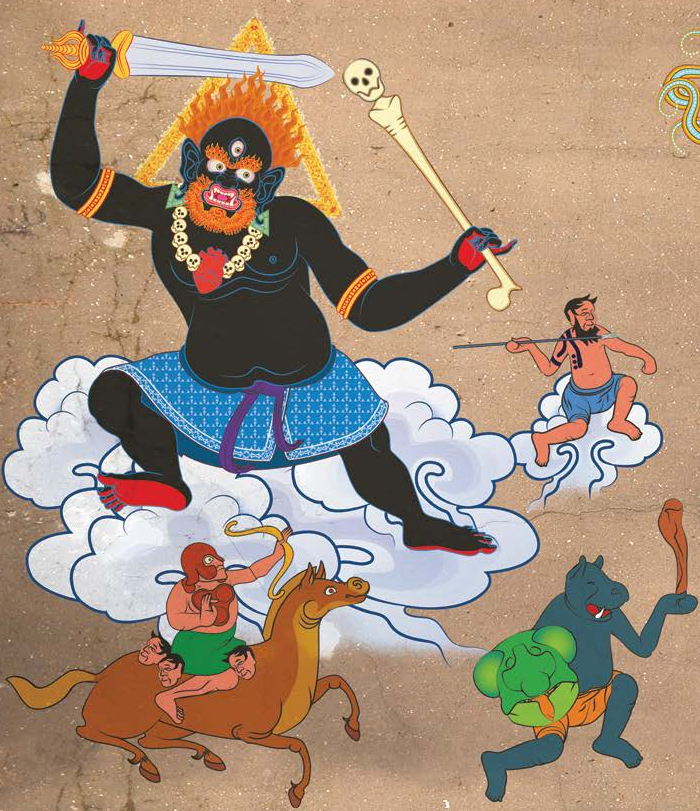
Now to me, I can’t help but think of Arkat as a Buddhist tantric demon-killing bodhisattva born in the most anti-spiritual society imaginable, who weaponizes perfect austerity and then weaponizes perfect transgression in exactly the same way. Decades of perfect, inhuman discipline; total mastery of body, energy, and mind; complete suppression of the eight worldly concerns; and then, the instant he steps outside the mandala of Brithos, he begins the antinomian phase. He is initiated into abhiṣeka, starts breaking every vow, consuming every forbidden substance (ideological, emotional, metaphysical), sleeping with every “dakini” (the Orlanthi, the Seshnegi knights, Kyger Litor, the Illuminates), generating immense heat and power from the deliberate transgression.
In tantric terms, Arkat spends the first thirty-five years of his life as the perfect kyerim practitioner locked in the utmost austerity of the Brithini “generation stage”: visualizing himself as the impersonal, caste-bound deity, never wavering for a heartbeat. The 100 Routines and 35 Weapons forms are his mantra recitations and mudrās. The decades of sorcery cast on him are the external abhiṣekas that stabilize the “deity body.” The fact that he can fight for five days straight without fatigue is the Brithini equivalent of the siddhi of “non-exhaustion” that kyerim practitioners are supposed to develop. Then, the moment he reaches the mainland, he flips into dzogrim: total identification with Death, illumination, the void, whatever you want to call it, then re-emerging on the other side as the protector-deity who founds secret cults that can wield all of that power without being consumed by it.
And just like the wilder Buddhist tantric stories, everyone who meets him is either liberated or damned. There is no middle ground. You become an Arkat, or you become a victim of Arkat. The tantric hero and the demonic destroyer are the same being, depending on whether you have the capacity to recognize what he now is. Arkat and Gbaji, two faces of Nysalor.


I did preface this with “This is a DEEP background post and irrelevant for most games.”
A totally non-Glorantha, non-TTRPG book that nonetheless was very influential on the Guide and how I view Arkat is: The Taming of the Demons: Violence and Liberation in Tibetan Buddhism (2013) by Jacob P. Dalton.
We can have even more fun if we map Arkat’s life along the seven-stage mahasiddhas path, as Arkat lives the entire seven-stage tantric stages, not as metaphor, but as literal world-shattering events.
- For thirty-five years he performs the most extreme generation-stage (kyerim) practice imaginable: he becomes a Brithini Horali, a living, impersonal embodiment of Malkion’s Law. No ego, no desire, perfect divine pride in pure function—he masters this long and flawless.
- He then deliberately shatters that perfection by becoming a passionate Hrestoli knight. Love, quests, poetry, and the Joy of the Creator ignite his first taste of descending bliss and inner heat —the classic “monk meets the girl and the dam breaks” moment.
- On the battlefield he meets the wrathful guru in the form of Humakt. He literally dies and is reborn as Death incarnate. The sword severs every remaining trace of his previous identities.
- He descends into the underworld and is adopted by Kyger Litor, living as a mistress race troll in absolute primordial Darkness. This is the retreat into the mother clear-light, the black womb before creation—the rare and fearsome “charnel-ground” stage taken to cosmic scale.
- At the deepest point he voluntarily becomes Gbaji the Deceiver, the Bright Devourer, the chaos-antichrist who betrays and destroys everything. This is the forbidden final test of the mahāsiddhas: deliberately becoming the monster to prove that nothing, not even ultimate evil, can stain awake awareness.
- In the final duel atop the Tower of Illusion with Nysalor/Gbaji, he recognises that Darkness and Brightness, betrayal and loyalty, chaos and order are all empty-luminous mind. Mother clear-light (stage 4) and son clear-light (his own rigpa) unite. Full enlightenment in the midst of apocalypse.
- He returns as the hidden siddha: founder of the Autarchy, the Dark Empire, and the secret Arkati/Stygian cults. He is now the unpredictable protector-destroyer, saviour and devil in one, walking the world in whatever form is necessary, liberating some and damning others with the same glance.
He became Gbaji! Only the one willing to become Gbaji can finally defeat Gbaji.
But before you say that perhaps then the fight against Gbaji is pointless, let me tell you that fighting Gbaji was still necessary, even inevitable.
The paradox is not that the fight was wrong.
The paradox is that only a fight that goes all the way through the mirror can succeed.
Gbaji is not just an external enemy.
Gbaji is the bright, deceptive promise that illumination, power, or enlightenment can be seized without cost, without descent, without becoming the monster yourself.
Nysalor’s gift looked like pure light: instant cosmic unity, freedom from duality, godlike insight — handed out freely, no darkness required.
That promise is lethal because it freezes the world in a false perfection.
It traps beings in a radiant stasis where nothing can change, nothing can die, nothing can be reborn.
It is the ultimate imperial illusion: “We have arrived. No more struggle needed.”
So yes — Gbaji must be fought, because surrendering to that bright deception is spiritual death.
But the only way to truly defeat it is to refuse the shortcut and take the long, savage road:
Descend into the opposing darkness.
Become the very monster you fear.
Meet the deception on its own ground and recognise that brightness and darkness are the same empty-luminous mind.
When Arkat duels Nysalor/Gbaji in Dorastor, he has already been Gbaji.
He knows the seduction from the inside.
That is why he can shatter it without replacing it with another frozen empire.
The fight was necessary.
But victory required refusing to fight cleanly.
A purely good, purely bright, ego-bound hero would only have become the next Gbaji.
Only the one willing to stain himself beyond recognition can cut the root.
So we should have fought Gbaji — and still must, every time his bright promise reappears (Red Moon, any utopian ideology that says “surrender to us and be free forever”).
But we win only by becoming what we fight, seeing through it, and returning as something the old world calls demonic.
That is why the liberator always looks like the destroyer from the perspective of the illusion being destroyed.
Fight — yes.
But know that real victory passes through the heart of the enemy, not around it.
Now for those of you who are pro-Lunar this should not be seen as comforting, as Argrath is the second turning of the same wheel that Arkat once spun. Arkat was the dark, left-hand completion; Argrath is the stormy, right-hand completion. Same siddhi, different expression. Two turns of the wheel.
Same enlightenment.
Same terrifying, unpredictable, world-shattering activity.
The more I contemplate Arkat, the more likely I will trigger Storm Bulls in my vicinity. Those Storm Bulls did appreciate Arkat, even when he went to the Darkness. After all he did fight a LOT of Chaos. Broos, vampires, scorpion men, gorp gods, you name it – all of those got sent against him.
But regardless of whether you buy this take on Arkat (and Argrath), the first part of this is accurate. I just find looking at the mahasiddhas path (with Nysalor as a false siddha) as a fascinating parallel, and one Greg certainly was aware of when he wrote the story. Nysalor is a cautionary tale about the “fast route” to liberation. He embodies the seductive promise that enlightenment can be handed out instantly, like a gift of bright light, without the long, savage, ego-dissolving work of the full path. Everything else works backwards from that.
One last thought – the supreme irony is the Red Goddess completed the EXACT SAME mahasiddha cycle.
She died, descended, integrated chaos, recognised the ground, and returned as a liberating force.
She is not a false siddha in her personal myth — she is one of the most complete figures in Gloranthan God Time.
The irony is that her achievement calcified into a phase. By manifesting as the immortal Red Moon — eternally visible, eternally balanced, eternally inclusive — she freezes her own realisation into a cosmic institution.
Her enlightenment became an empire.
Her illumination is offered as a gift (like Nysalor’s, but more sophisticated).
Her cycle is projected forward as the White Moon promise — a future perfection that keeps beings striving within the Lunar framework.
Her integration of chaos and darkness is enforced from above, by an undying goddess and her imperial masks.
The personal completion of the Red Goddess becomes the collective cage of the Lunar Way.
She achieved the full cycle — and then, in compassion, tried to give it to everyone without requiring them to die, descend, and become the monster themselves.
That is the ultimate fast route, wrapped in the most beautiful packaging yet.
And to answer a few questions, Argrath does not begin as a fully realised siddha who coolly recognises the Red Moon as a compassionate but transitional phase.
He begins as a wounded, furious mortal — orphaned by Lunar violence, enslaved, exiled, burning with perfectly ordinary hatred for the empire that destroyed his family and his world. He is, in the beginning, as ego-bound as any rebel hero.
His illumination cracks the ego, but does not yet dissolve it.
He learns he is Arkat returned, gains the tattoo, embraces the contradictory path — but much of his early conquest phase is still fueled by that original fire of hatred transmuted into charismatic, world-conquering ambition.
Only through the full, terrible immersion — the years in Hell during the Lightbringers’ Quest, the alliances with ultimate monsters, the personal mistakes and losses (Feathered Horse Queen slain, quarrels, empires devoured) — does the ego finally burn away.
Only then, at the absolute nadir, does the Ground Recognition arrive.
This parallels with Arkat. Arkat began hating the Bright Empire for perfectly ordinary reasons (betrayal, destruction, chaos).
Only after being killed, becoming troll, becoming Gbaji, resting in absolute Darkness, could he meet Nysalor on the Tower with true recognition — no longer as an enemy, but as the one who must deliver the final blow out of love for the ground itself.